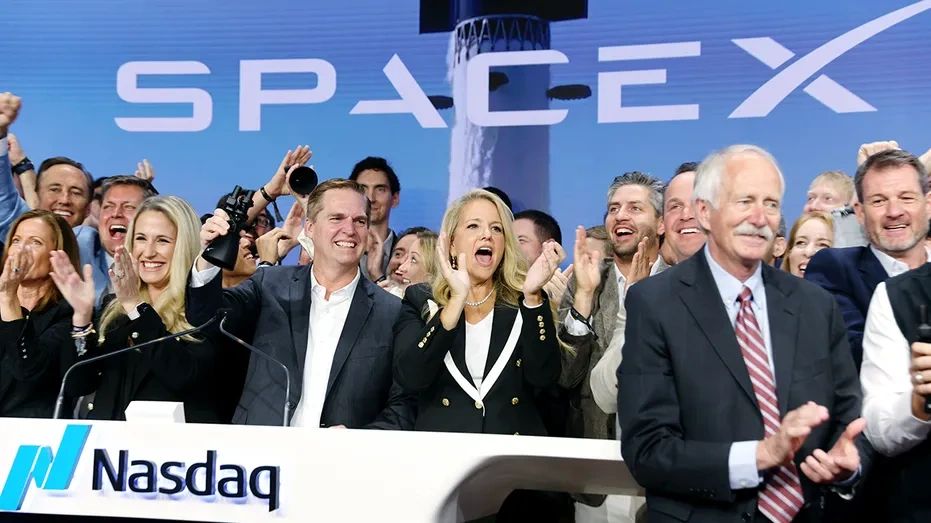
Just days apart, the three behemoths of the AI Race, SpaceX, OpenAI, and Anthropic, have converged on the public markets, ready to stake their respective claims, and edge the remaining two out, on interstellar domination.
This week, SpaceX (which acquired Musk’s xAI in February of this year, and just closed a deal to acquire Cursor for $60 billion) has entered the scene with authority, reaching a valuation of over $2.6 trillion only days after hitting Wall Street, raising questions about whether this heady figure is justified for a company that lost nearly $5 billion last year, despite generating 20% of its revenue directly from government contracts with the United States. Still, Musk continues to shoot for the stars, and his networth eclipsing a trillion dollars only served to add to the spectacle as SpaceX (SPCX) went on to rally well past what many others have speculated it should be worth.
Although a certain space-exploration company may have stolen the spotlight, Anthropic and OpenAI each filed their S-1’s to much fanfare, signaling their intentions to follow suit. The timing of these filings has added a seemingly manic tension to the conversation around Artificial Intelligence, which has become the mainstay of nearly any conversation taking place on the markets these days. However, as excited as investors and employees of these companies might be to get a piece of the AI pie (and the unfathomable wealth that comes along with it), the underlying financials of soon-to-be-listed Anthropic and OpenAI have drawn significant scrutiny, calling into question the promises of splendor that Musk, Amodei, and Altman claim will result from the advancement of this nascent, and dangerous, technology.
As it stands, the AI Industry is almost single-handedly propping up the US stock market, with trillions of dollars in capital expenditure flowing into the construction of new data centers, hyperscaling chipmakers, and the infrastructure that will ultimately support the lofty goals set by these titans of industry. Nothing seems capable of dampening the enthusiasm surrounding the valuations of these three companies, not even the fact that not a single one of them is profitable as of today. Of course, Anthropic projects that it will have its first profitable quarter in Q2 of this year, but even this is based on the projection that their revenue will effectively double. By its own admission, OpenAI doesn’t expect to turn a profit until 2030, and even suffered a net loss of $39 billion in 2025, none of which has stifled interest in its public offering at an eye-watering $852 billion valuation.
Just a single company going public at valuations such as these would be enough to remain cautious, but the culmination of this trilogy seems to be nearing the fantastical. All told, the sum of the valuations for SpaceX ($1.75 trillion), Anthropic ($965 billion), and OpenAI ($852 billion) is set to eclipse $3.6 trillion, or nearly 5% of the total US stock market, before a penny in profit has been returned. This all comes at a time when the Magnificent Seven, all of whom are deeply entrenched in the AI Race on their own terms, account for more than 1/3 of the market capitalization of the S&P.
With all of this money floating around in orbit, we have to ask ourselves - are these arbiters of artificial intelligence also too big to fail, or are we witnessing the birth of another man-made market meltdown?
Team Players
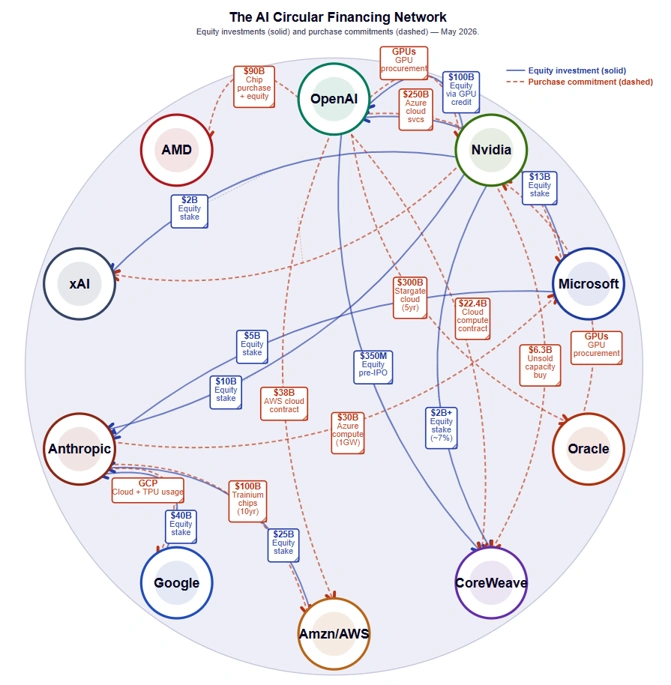
The market is booming in 2026, despite the obvious tensions looming - skyrocketing energy prices due to the conflict in Iran, waning consumer confidence, and the ever-present threat of another ‘bubble’ waiting to burst. In many ways, it feels as though all of the so-called ‘smart money’ is betting on the same horse, that the realization of the visions of these AI prophets will lead us into a new age of untold riches; well, at least for the lucky few at the top, anyways. Whatever happened to diversification?
Similar to the Enron scandal, an inside look at the ‘circular financing’ currently transpiring between the big players in the AI Race is troubling, to say the least. Take, for instance, OpenAI’s partnership with Microsoft, with the latter owning a 27% stake of the Altman empire. In April, the partnership was reorganized, with Microsoft ceding its exclusive licensing rights to the intellectual property (IP) of OpenAI, as well as its role as the singular provider of cloud computing. This effectively pits Microsoft Azure against its computing rivals, Amazon and Google, all 3 of which now stand as potential clients of OpenAI.
At the same time, Amazon has committed to an additional $25 billion (for a total of $33 billion) investment into Anthropic, which, in return, promises to purchase $100 billion in compute from AWS. To make things more confusing, Google has moved to invest $40 billion in Anthropic, all while Gemini, Google’s competing AI offering, is set to gobble up an additional $185 billion in capital expenditure in 2026 in the form of data center buildouts, TPUs, and other related infrastructure.
Chip giant Nvidia has also pledged big bucks, with a $40 billion investment into OpenAI coupled with a $10 billion investment in Anthropic. The money doesn’t stop there, however; critics assert that Nvidia is goosing its own numbers by investing in these companies, like OpenAI and CoreWeave, which then use these funds to purchase Nvidia chips, claims that the company vehemently dismisses. Nevertheless, Nvidia seems to be perfectly positioned to get rich in this AI gold rush by selling the shovels.
In the background, Meta has taken a different approach, namely poaching top talent from OpenAI and Anthropic while simultaneously conducting mass layoffs to support its own capital expenditures in developing proprietary models. To add insult to injury, Meta employees who weathered the storm were informed by Zuckerberg that their computer activity would be tracked in order to train autonomous AI agents, with the ultimate goal of replacing human workers altogether.
To put it concisely, it feels as though the big players in the AI space are willing to suspend their competitive spirit and help their competitors, so long as they get their piece of the pie in the end. It feels reminiscent of a game of musical chairs gone awry - who will be left on the hook for all of those billions when the music stops? Hint - probably not any of the executives at these companies making the decisions.
Collateral Damage

Amid the quest for Artificial Intelligence, it appears as though a crucial element is being overlooked by those writing the checks and calling the shots - the human element.
As efforts to quickly and efficiently scale data centers to support the compute power needed to run these models, the undeniable detriments have come to light. Although it is sometimes easy to pretend that AI doesn’t exist in the material world, this is far from the truth. Beyond the financial means needed to develop this new technology, new strains on resources, like fresh water, electricity, and more have risen to the surface as a point of major contention. This is one thing that we may not find in the S-1 filings for Anthropic and OpenAI, or on SpaceX’s balance sheet - the threat of derailment from the general public, who have quickly come to the realization that Artificial Intelligence constitutes an existential threat to themselves, and their livelihoods.
Despite setting the goal of building 24 gigawatts (GW) of capacity in data centers across the United States in 2026, nearly 50% of these projects have yet to commence. Apart from the significant issue of the failing power grid in the US and myriad expected delays, such as zoning, permitting, and more, municipalities looking to install new data centers are facing serious backlash from concerned citizens. In recent months, moratoriums and bans on data centers have been instituted in California, Missouri, Wisconsin, and more, and a poll from Gallup in May of this year shows that 70% of Americans are opposed to having these installations in their neighborhoods. For good reason, too - people living near xAI’s ‘Colossus’ campus in Memphis, TN are suffering the ill effects of Musk’s ambitions for AI dominance, including severe air and water pollution that threatens to make the area untenable.
Furthermore, the buildout of AI threatens ALL life, not just human. Studies show that integral functions of wildlife, like communication and migration, among others, are severely impacted by the expansion of these data centers, a risk that is not being seriously considered at present. Regardless of the record number of dollars being injected into the acceleration of this technology, I assure you that it will be a measly sum in comparison to what it will take to rebuild entire ecosystems that stand to crumble should this abuse continue.
So, what is it that we are really chasing in this race for AI dominance? Is a world with no jobs, a devastated economy, a ruined environment, and a handful of exorbitantly wealthy technocratic overlords really worth forfeiting all that we have right now? Maybe you should ask ChatGPT.