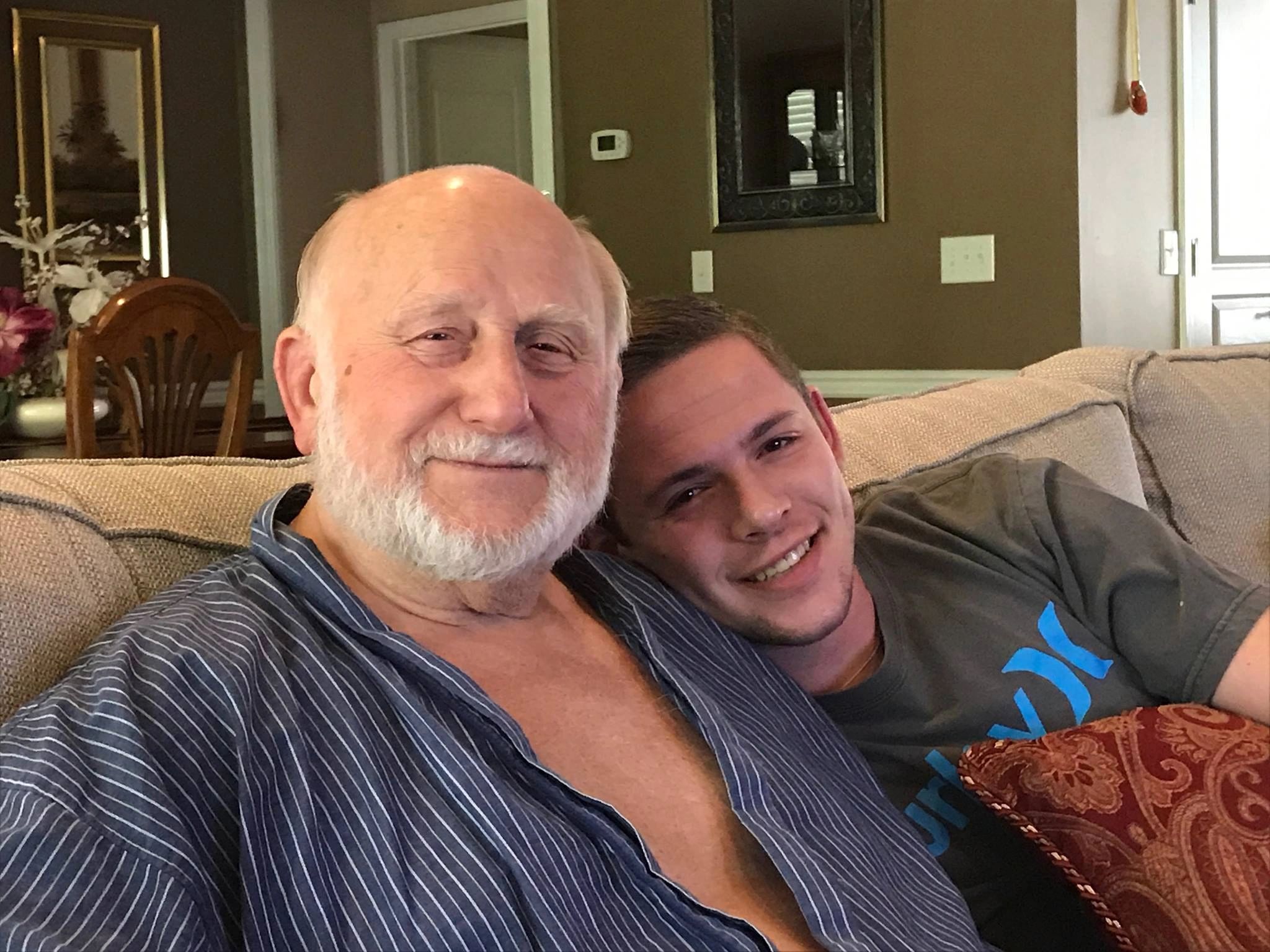
My grandpa is, without doubt, the glowing figure within my family. Although he may be in need of assistance sometimes and has adult children and even grandchildren, when the family congregates, everyone knows that, if Grandpa’s happy, then we are all happy. As I have matured into a young adult, I cannot help but notice the striking similarities between him and myself, even though I am a full generation removed.
At a young age, my grandfather moved from a small town in Slovakia called ‘Ubrez.’ There, his family were subsistence farmers, part of a small village that functioned as a self-sustaining unit: when milk was in need, there was a family for that; when the winter creeped upon the land, there was a place to buy and smoke meat for the long, cold months to come. This was a place untouched by the roaring wave of industrialization, left to live in simpler times, where church on Sunday was the main event, not a drive-in movie or a too-big burger at one of Jersey’s infamous diners. As an individual far removed from this starkly different lifestyle, it is almost hard to imagine how one can go from such a modest upbringing to integrating into the capitalistic and commoditized society that we have in the United States. Nevertheless, my grandfather and grandmother did it together, and remarkably well, at that.
Originally intending to join the seminary, he first landed in America to visit his father, who held a blue-collar job at a local factory. That place was Holyoke, New York, a place that he remembers by the summers picking strawberries at his family’s farm upstate, or by the single room that his father and he shared, not even equipped with a shower; he and his father generally bathed at the factory.
After some time, he decided that he no longer wished to pursue the priesthood, and ended up joining the US Army. He went for training from time to time at Fort Dix Army Base in Springfield, New Jersey. He found himself at one point in Germany, engaging in army training. Once he had returned, he rented a modest apartment in Newark, and pursued a degree in Accounting from Rutgers University at night. He fondly recalls getting his meals at a local diner, because his apartment didn’t have a refrigerator or any means of cooking a meal; a small desk and a bed were the only indications of residence. Working and studying, he completed his degree, and found a job at a small company called Merrimac, where he worked in the Finance department.
Driving his then-girlfriend’s car, my grandfather made it out to meet my grandmother for a date, who was also an immigrant from a small town called Glasgow, just outside of Ayr, Scotland. Before long, they had moved into a modest home in Rockaway, NJ, the place that they would call home for many years to come. There, they raised a daughter (my mother), and two sons, Michele, Steven, and Mark, respectively. My grandfather rose quickly within Merrimac as the company continued to grow, eventually landing the position of Vice President and Controller.
Now, he resides in a quaint retirement community in Fort Mill, South Carolina, close to his youngest son in neighboring North Carolina. We visit at every opportunity, and that same feeling of going to ‘Grandma and Grandpa’s’ still fills me with expectation, just as it had in childhood.
I firmly believe that I learned some of life’s most-important lessons from my grandparents. From a young age, I noticed the sense of joy and generosity that they exuded. It was rarely a time when they didn’t have their hands full of presents or candy for my younger brother and me. I also remember being excited to take home the ultimate treat after dinner with Grandma and Grandpa: half of a lemon for each of us, which we would gleefully use to make funny faces at each other on the car ride home.
At Christmas and other holidays, I learned to love Slovak kielbasa and Walker’s shortbread, just a few of the pieces of their cultures that my grandmother and grandfather had taken with them from their homelands. In the summers, my brother and I would run tirelessly around the lawn, entertaining ourselves as the grill sizzled with cheeseburgers that far outclassed McDonald’s: they were grandma and grandpa’s burgers, with the bun toasted and the cheese melted. Honestly, what could beat that?
I remember many family holidays filled with outbursts in Scottish and Slovak accents alike, and the dangerously red hue that my grandfather’s face would take on as he laughed at some incomprehensible joke that he had read somewhere. My grandparents were very refined people, despite their modest upbringings; the table was always set meticulously, and how to hold a fork and knife properly was a lesson that my brother and I learned from a young age. ‘When you hold your silverware, pretend that you are holding a book in each arm.’ This was where I learned to eat European style, with elbows in and both a knife and fork in hand at all times, even when one or the other wasn’t needed. It was considered ‘improper’ to place your silverware on your plate as you ate, I learned. Even today, I cringe as I watch some people with improper ‘dinner-table etiquette,’ as I call it, reflexively pulling my elbows to my side in a futile attempt to have them do the same.
One of my earliest memories started with the sharp sound of a power-washer that rose from beneath my bedroom window: it was my father and grandfather cleaning up the deck before a new coat of lacquer. The sun was ever-so bright, and poured in through my undrawn blinds. My grandfather was good with his hands, and rightfully so: he had been tending to the family home and fields from a young age. My brother and I were so eager to show our grandparents that we could help, too, which resulted in the two of us bringing our plastic hammers to cut down the family Christmas tree one day. We still laugh about the picture, my brother and I holding our tools high, beaming with the pride of our ‘contribution.’ You had to work hard to get by in America, there was no way around it.
Once, as we pulled out of a strip mall in some small Jersey town, the car approached an intersection. On the corner, a disheveled man stood with a cardboard sign, which briefly explained his situation. He had no money for food, it said. Without hesitation, I watched as my grandfather removed his wallet, handing the man a crisp $20 bill. Just like that. The man smiled and thanked him, excited at the idea of a hot meal for the day. When I think of generosity, I think of that simple act. Whether the man was drug-addicted or otherwise, my grandpa gave him the benefit of the doubt, and shared money that, in his mind, was much better off in the hands of someone who truly needed it.
I always took pride in my outfit for Midnight Mass on Christmas. Grandma loved to see her ‘two handsome grandsons’ all buttoned-up for the night. When we came home from that late-night mass, we sat down and snacked on kielbasa and sauerkraut soup, two staples of a Slovak’s Christmastime feast. Then, we sipped tea and munched on shortbread as the ‘Banana Boat Song’ blared from two speakers in the corner of the room. Of course, it was always followed closely by ‘Tiny Bubbles,’ a personal favorite of Grandpa’s. He was often unable to speak between his boisterous fits of laughter at the absurdity of the lyrics, or at least his absurd interpretation of them. Grandpa loved to laugh, and we loved to watch him laugh. By the time the joke had been told in its entirety, the punchline had been long-forgotten, lost amongst the cacophonous bursts of laughter that filled the family room. When everyone had finally caught their breath, Grandpa would look around for confirmation: did everyone understand just WHY that joke was even funny? Most of the time, we didn’t. I’m happy to say that that hasn’t changed, and his jokes still aren’t (that) funny.
My grandparents always made an impression with their favorite dishes at dinnertime. Grandma instinctively grabbed for the salt, well before she had even tasted the food, which drew pleas from around the table, everyone urging her to ‘at least TRY it first!’ Grandpa’s chili, however, remains the crowd favorite, and mine as well. Even if you didn’t particularly love Grandpa’s chili (which was never a problem of mine), you had to admit that it was pretty tasty. ‘Do you want my recipe?’ he’d ask, as we rested in our chairs, exhausted from a feast that felt more like a food marathon. ‘The secret,’ he’d always say, ‘is a can of tomato soup. It makes it creamy.’ One early morning, before a long trek from grandma and grandpa’s in Asheville, North Carolina to North Jersey, grandpa laughed and laughed when I said that I didn’t want eggs or cereal for breakfast; I wanted a big bowl of grandpa’s chili, of course. Food was always an important part of our family gatherings. It dictated how the day was to go, each meal carefully planned to satisfy everyone’s hunger at just the right time.
Grandpa’s loss of hearing has provided more than one hilarious memory over the years. Even now, when one of us doesn’t hear something properly, we follow it with an ‘aaahh-what?’ or a ‘that’s the first time I’m hearing this,’ two of Grandpa’s signature catchphrases. One of the best incidents came when my grandparents were trying to get out of the house in a rush. My grandmother had said something about flowers or power or hours, something that definitely didn’t warrant my grandfather’s exasperated ‘what the hell are you getting in the shower for?!’ You would think that cases like this would prompt him to improve his hearing somehow, but Grandpa never bought into the premise of ‘hearing aids.’ In fact, the most useful function, he found, was the shrill squeaking noise that they made when he pressed them against his ears. ‘They’re working!’ he’d assure us, as we rolled our eyes and waited for more hilarious misunderstandings.
Grandma and Grandpa were always concerned with making sure that everyone had had their fill. ‘Seconds for anyone?’ they’d asked, brandishing a still-full pot of chili or a platter laden with piles of hamburgers and hotdogs. Each growing up in the years following the Great Depression, Grandma and Grandpa always wanted everyone to have their fill. Most of the time, we’d just groan and say that we’d had enough, there was no room for anything else! This myth was quickly broken when the chocolate cake was laid at the center of the table. My brother and I fought over the over-sized chocolate chunks that lined the outside of a double-chocolate cake. Needless to say, the cake didn’t have much of a chance.
I remember being intrigued by my grandmother’s habit of calling candy ‘sweets’ and labeling some mess or other ‘thilthy,’ a mispronunciation that my mother had unknowingly adopted over time. ‘Mom, why do you say ‘thilthy?’ It’s ‘filthy,’ with an ‘f!’ Mom paused, frozen in thought, before erupting into a laugh that could only be compared to Grandpa’s. ‘I don’t know! That’s how Grandma said it!’ she exclaimed, before another bout of laughter took hold. I always looked on with displeasure as my grandma relished her black liquorice, which, in my youthful opinion, tasted more like medicine than candy. Her face would light up as she told of her eccentric aunt, who would slip ‘chocolate but-buts’ into her wee, little Scotty dog’s bowl for dinner. She loved Scotty dogs, my grandma. It was something that reminded her of home, a place that she hadn’t seen too frequently since leaving at 21.
We got to see just where Grandma had been brought up. Glasgow was a small town, where it rained nearly every day, several hours by car from the gem of Scotland: historic Edinburgh. My brother and I snacked confusedly on sandwiches of shredded cheese and butter, something that, admittedly, tastes better than it sounds. We washed them down with ostensibly orange ‘IRN BRU,’ a fan-favorite soda in Scotland. It was something that looked a lot like orange soda, but was infuriatingly tricky to pin down; the flavor simply didn’t resemble anything that we’d had up to then. On our way back, my brother and I made sure to stow some of the empty bottles in our suitcases, to remember the days that we had sat in the bar at our hotel and sipped down IRN BRU like the proud Scots that we were. We had to make room, of course, for the heaps of British candy that we had bought at the corner store. We even took pictures of our candy mountains, which surround the beaming face of my brother as he lies on a bed in the picture that we took on our disposable Kodak cameras. We’d had to use British pounds to buy the stuff, so it didn’t register when the cashier let us know that our baskets would cost us 24 of those mysterious notes of paper. ‘You spent over 20 pounds on sweets?!’ We just smiled, and took another big bite of our ‘Cadbury Flake’ bars.
Whenever someone gasps in frustration that ‘you’re too damn stubborn,’ I only have one response: like grandfather, like grandson. ‘It’s that Slovak blood,’ my mom would say. My uncle prefers to grab him by both sides of the forehead and kiss him on his lobe, letting him know that he was lucky that we all loved him, or else we wouldn’t put up with his rituals and habits. When the meal was served at a restaurant, everyone would watch with bated breath as Grandpa took his first bite. If it was Grandpa-approved, then it was a good restaurant. When it wasn’t, Grandpa was always quick and plentiful with his suggestions, available both in-person and by letter. ‘I’m going to write them a letter,’ he’d say, regardless of whether it was to be positive or negative.
When some of us became frustrated with Grandpa’s stubbornness, he’d assure us that he was ‘out of it.’ ‘It’s up to you,’ he’d say, making sure that we knew that he was no longer part of the decision-making process. Nevertheless, we all knew that he was still very much involved.
These are the small memories that have shaped me, and taught me so much. Be kind. Be generous. Don’t be afraid to laugh at (or tell) bad jokes. Take care of your family. Work hard. Adapt to your surroundings, but don’t forget your origins. Make sure that you pronounce every letter as you shout a German goodbye at someone. You know, the important things in life.