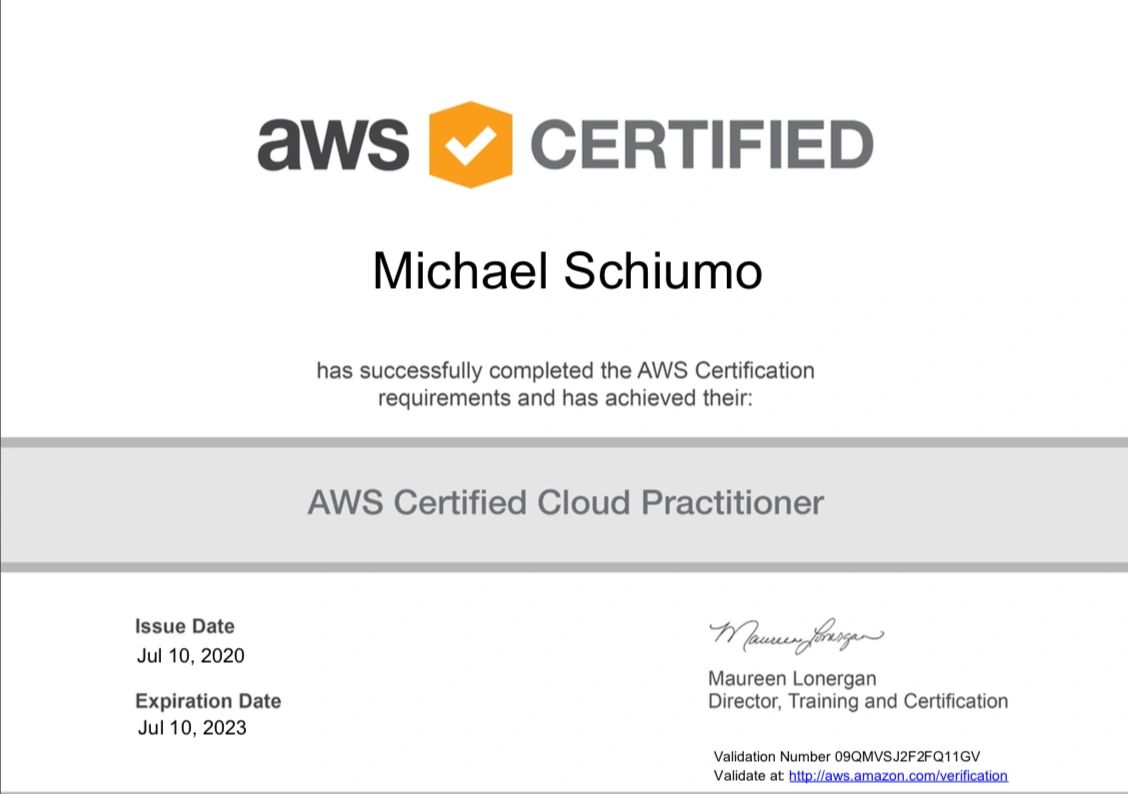
As someone who is making his first foray into Tech, I am always looking for ways to give me an edge, and demonstrate that I have the ability to learn new things quickly and effectively. I have been advised several times recently to look into sitting for a Cloud certification. Due to the fact that AWS is the industry-leading Cloud Services Provider (edging out Microsoft Azure and Google Cloud), I decided that the AWS CCP was a good place to start.
View the original article on Medium
The Certification
Now, one important thing to mention is that this certification demonstrates a foundational understanding of Cloud principles, AWS Services, and other aspects of the Infrastructure as a Service platform that AWS offers, including billing, pricing, and security. It is the first step in achieving higher certifications, such as the Solutions Architect Associate, which is my next target. It does not, by any stretch, mean that you are an “expert” at AWS. The sheer number of services that AWS and its Partners offer is astounding, and definitely made my head spin.
There are no requirements for taking the exam in terms of prior certifications or experience — anyone willing to put in the time and effort, and pay the $100 fee, can pursue this certification. You can learn more about AWS Certifications here.
Preparation
In the spirit of channeling my former, collegiate approach to studying, I decided to go all in. I studied for about 20–25 hours over the course of 3 days in order to prepare. The exam makes it clear — you either understand the question and know the answer, or you don’t. Guessing on this one proves difficult.
As always, I scoured the web for resources, and found some truly inspiring mentors willing to share their knowledge and experiences. Below, I will list the resources. Per my typical approach, I consumed as much as I could, and created a formidable pile of notes in the process. I will attach links to those as well.
Note: there are many opinions about what is necessary to actually “pass” this exam. However, I found that using a few trusted resources does the trick just fine. Additionally, I don’t recommend taking the exam on such a time crunch, as it is definitely stressful and overwhelming at points. There is a lot of information to consume, and it takes a while to digest.
Resources
-
Udemy AWS Certified Cloud Practitioner 2020 (for practice exams)
-
AWS Certified Cloud Practitioner Training 2020 Full Course (FREE!)
What to Focus On
Diving head first into AWS without prior experience is definitely an experience. There is so much to learn when it comes to understanding Cloud Computing and how AWS provides what is known as “Infrastructure as a Service.” The CCP exam is highly focused on definitions, acronyms, and distinguishing between different offerings. With hundreds of acronyms, it becomes a word jumble relatively quickly. Don’t worry, I included a slide from the Training Course above that spells out the major ones.
This exam requires high attention to detail. Due to the fact that there are so many services, and some of them overlap, it is important to reduce the options into reasonable choices — don’t just click the first answer that you see and assume that you’re good. Read the question more than once, and go back again if you’re not sure. The PearsonVue service allows you to flag and review questions before submitting the exam.
Study Techniques
As with many tasks in life, studying for this exam comes down to one thing — iteration. Watch as many tutorials and walkthroughs as you can, take as many notes as you can, and definitely take as many practice exams as you can. I purchased my sample practice questions on Udemy, along with the AWS Certified Cloud Practitioner 2020 course, which totaled $46. If you’re new to Udemy, I would suggest subscribing to their mailing list. There are many sales that offer courses for $10, which is an unparalleled deal.
Note: I wouldn’t recommend using the above course on Udemy as your primary study resource, as it is a very long (16 hr.) course, and has a lot of walkthroughs of the AWS Management Console that aren’t absolutely necessary for passing this exam. However, the sample practice questions are perfect for simulating what you will see on exam day. Due to the fact that I studied and sat for the exam so quickly, I was taking practice exams right up until the exam started, and was scoring ~75%. For reference, the passing score is ~700/1000, and can be adjusted periodically. I passed with an 809/1000, meaning that my actual result was better than my practice exams.
Read. My. Notes. You won’t regret it. You will find many resources for studying for this exam, but I have yet to come across a written study resource that encompasses all of the materials. I am not taking credit for creating any of this content — I simply consolidated it, and added detail when needed.
Finally, watch the Training Course listed above at least once. Andrew WC Brown does a wonderful job of explaining concepts, and giving you just enough to understand the concepts clearly for the exam. Once again, this exam is not a test of whether you are an expert — it just shows that you have a foundational understanding.
What to Expect
I didn’t really know what to expect going into this exam, and I made the reservation on AWS to sit for it without preparing beforehand. Due to current circumstances, I decided, for safety and convenience, to take the exam from home through PearsonVue.
Essentially, you pay $100 to sit for the exam, and can reschedule up to 2 times before you are charged. The exam is 120 minutes in duration (65 questions), and can be taken from any room where there is reliable internet, so long as the virtual proctor deems the workspace clean of anything that may influence the results of the exam, i.e. additional monitors, phones, other devices, and notes. It took me about 10 minutes prior to the exam to go through the security checks and receive clearance from the proctor.
Once I started the exam, I tried my best to not second-guess myself, and completed the exam in about 20 minutes. I went through the first round, flagging questions that I wanted to review. I ended up flagging about 3–4 questions, and decided to leave my answers as they were. I clicked submit, and, boom — passed!
You will not receive the certificate immediately, as the proctors must review the recording of the exam to ensure that there was nothing dishonest taking place. Then, you will receive an email, a PDF, and a nice badge to post to LinkedIn to verify the credential.
Last Minute Tips
Here are some tips to keep in mind before taking the exam.
-
Make sure that you are doing practice exams so that the concepts are fresh.
-
If you answer incorrectly during a practice exam, mark the question and the answer for later review.
-
Take breaks when studying. Some of the material is dense, so it helps to get away from it for a few hours.
-
Make sure that your workspace is prepared — no notes, no monitors, no ACDC posters, no open windows, and no leaving the room. You don’t want to lose $100 because your dog decides to push the door open in the middle of a particularly difficult question on the difference between AWS RDS and AWS Aurora.
-
Make sure that you go into the exam energized and focused. Even though I finished in about 20 minutes, I was hyper-focused on every detail, including the wording, of the questions.
-
Don’t second-guess yourself. If you feel confident in an answer the first time, don’t torment yourself by flagging 15 questions and potentially giving incorrect responses.
The Final Thought
The AWS CCP exam was certainly more difficult than I had anticipated. Learning more about AWS, and Cloud Computing in general, has given me a newfound appreciation for the mind-blowing progress that has been made in technology, and how fast things move in the industry. Passing the AWS CCP is just the tip of the AWS Glacier (you’ll find that funnier when you start studying, trust me).
Starting off with the CCP is a great way to get exposure to AWS, and is the first step in achieving industry-recognized certifications that demonstrate your competencies in Cloud Computing and problem-solving. You can do it!
If you’re feeling generous, I like lattes! Leave a comment on how you did on the exam. As always, Happy Coding!