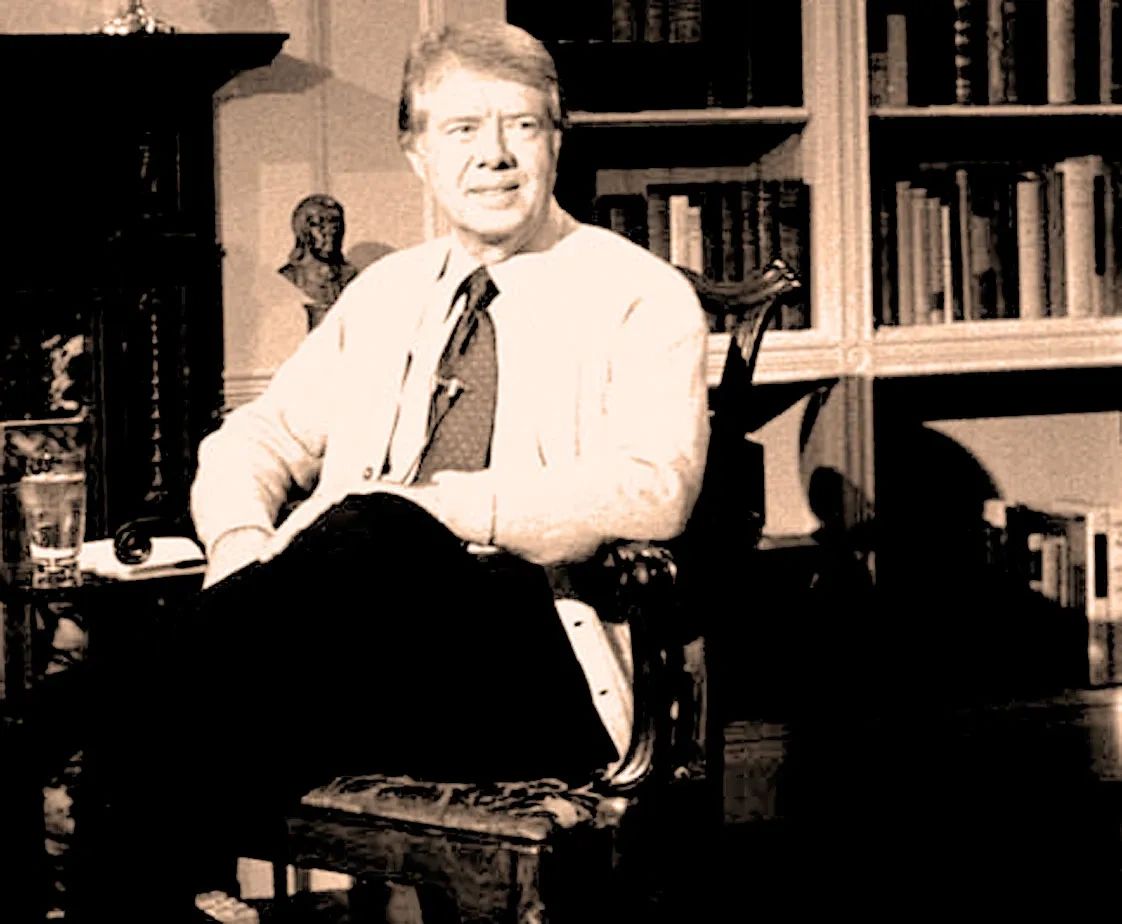
With the recent passing of Jimmy Carter, I took some time this past week to look back on his life, and perhaps learn a few new things about him as a person, and as a president. It turns out, Jimmy Carter lived a remarkable life.
From humble beginnings in a simple farming family in Georgia, Carter was, by all metrics, an unlikely candidate for the presidency. After just one term as governor of Georgia, he announced that he was, in fact, ‘running for president.’
Although he was decidedly on the lower end of popularity as a president, he has some pretty significant achievements. He is the first president to live to triple digits. He and his wife, Rosalynn, had the longest marriage of any American President and First Lady, going strong for 77 years. In 2002, he won a Nobel Peace Prize for his efforts at championing human rights. He was also one of the only American presidents to enact meaningful, peaceful change in the Middle East, encouraging Egypt and Israel to sign a treaty in 1979 at Camp David.
Perhaps more remarkable was what Jimmy Carter chose to do with his life after leaving office. Following in the footsteps of Truman, Carter lived a life of simplicity, returning to his family home in Georgia, and straying from the tradition of former presidents leveraging their previous rank to enrich themselves and enjoy other social privileges. Carter, alongside his wife, continued to serve the nation, and the world, through various enterprises, including the Carter Foundation and Habitat for Humanity.
Of all of the fascinating things that I learned about Jimmy Carter throughout the week, none captured my attention more than what has become a symbolic representation of his unique tenure as president - the so-called ‘malaise speech,’ which is officially titled the “Crisis of Confidence.”
What began as a simple, fireside chat has become a definitive mark of Carter’s presidency, and, when looking back on it, a sure sign that he was, in many ways, simply ahead of his time.
The Crisis of Confidence
The “Crisis of Confidence” speech was broadcast on television in the summer of 1979, a time of general discontent amongst the American public. Most prominently at the center of attention was the Gas Crisis of 1979, which left many Americans without reliable transportation, and, consequently, searching for answers and solutions from their fearless leader, Jimmy Carter. This, along with less-than-favorable economic conditions due to stagflation, left many disgruntled, and ready to let their representatives in Washington know.
As he was known to do, Jimmy Carter approached the subject with a great measure of integrity, aiming to frame himself not as a politician far-removed from the banality of the situation, but as an American citizen looking to contribute in what small ways he could.
In the preamble to the speech, Carter begins:
It’s clear that the true problems of our Nation are much deeper — deeper than gasoline lines or energy shortages, deeper even than inflation or recession. And I realize more than ever that as president I need your help. So I decided to reach out and listen to the voices of America.
Throughout the speech, Jimmy Carter appeals to the collective pride of Americans in their ability to unite and serve the common good, to bring about change through sacrifice and fulfilling their civic duties. These were not empty words, either; Carter was known to practice what he preached (and yes, he did preach, too), including wearing sweaters in the White House after asking the staff to lower the thermostat, installing solar panels on the roof of the President’s residence, and setting ambitious goals for the United States to begin its path to reducing its reliance on fossil fuels in favor of renewable energy sources.
At the root of this speech is something that truly struck me - the idea that, in order for America to become better, we must all make small changes that, collectively, amount to change on a larger scale. In essence, the distinct mark of individualism amongst the American populous was, Jimmy Carter felt, impeding societal progress. A malaise, you might say.
So, how has America fared in its battle with this “crisis of confidence” over the past 4 decades, and where do we go from here?
E Pluribus Unum
You don’t have to look hard to find the ubiquitous symbols of unity that our founding fathers imprinted on this nation. In fact, it’s printed on every dollar bill in circulation: ‘e pluribus, unum,’ which, translated from Latin, means “out of many - one.” Yet, in today’s America, it feels as though we are moving further away from this nation of unity that was conceived so many years ago. In my experience, American society has come to elevate the needs of the individual above the many.
A simple example that comes to mind is the not-so-distant reality of COVID lockdowns and restrictions. Although it was presented as a means of mitigating risk for vulnerable groups, such seemingly innocuous and simple measures as wearing masks, social distancing, and being cautious were touted as ‘unconstitutional,’ or simply a ploy for the government to exercise even more control over its constituents. Yet, had these become standard practice, as they did in countries that fared well with COVID (take New Zealand, for example), there is a strong probability that the death toll and general repercussions of this deadly pandemic would have been far less.
Another unavoidable reality of daily life for many Americans is homelessness, whether they are subject to it personally, or live in areas heavily affected by this issue. Although it is true that mental health and drug use play a role in homelessness, I find that it is a common response from a passerby that a person in this situation in some form deserves it, or is not doing enough to escape it or better their situation. Michael Jordan, a billionaire who made his money playing basketball and selling shoes, notoriously refused money to a homeless man because, in his words, ‘If they can ask you for spare change, they can say, ‘Welcome to McDonald’s. Can I help you, please?” Now, not only is this a striking display of apathy, but also a gross oversimplification of the issue as a whole. Is it truly realistic for someone without a place to live to have the necessaries to even apply for a job? Without a home address, it’s hard to have a driver’s license. Without proper attire, it’s hard to show up for a job interview. Without access to consistent medical care, it’s hard to stay physically fit and meet the demands of the job. The list goes on, but one simple fact remains - that person is still your fellow American.
Of course, as it often does, this conversation inevitably flows into the politics of today, which are inarguably divisive, and designed to be so. Rather than see those with different political affiliation or beliefs than us as ‘fellow Americans,’ we are inclined to see them as foe, as opponents who must be defeated.
It seems that we have forgotten that we do, indeed, play for the same team.
The Way Forward
When I was a student, I had the opportunity to live abroad, in Kazakhstan, for a year. During that time, I lived with a host family comprised of one woman, a metallurgical engineer born and raised in the Soviet Union, who has since become a member of my own family due to our close bond. Her name is Larisa.
During the first months, it was hard for me, an American, to comprehend as she touted the positives of a communist society. Inexorably, the Soviet Union experienced a great deal of hardship; yet, night after night, as we sat at a comically small table in her even smaller kitchen, sipping tea and reminiscing, I watched as her eyes lit up with tales of the great spirit of their society. ‘Anything was possible,’ she would say.
She would often marvel at how such a large society comprised of so many races, ethnicities, creeds, and more had come together to achieve common goals, how they had built arguably the most-robust educational system on the planet at that time, and competed against the United States in the Space Race and even the Nuclear Arms Race. Everyone was a ‘comrade’ in those days, and there was no notion of class division. Everyone received a free education, and the same social services (with obvious exceptions). Of course, this was no paradise, but, at the very least, everyone could feel as though they were a part of something larger than themselves, Larisa would explain.
The United States once held that vigor, too. It was distilled in the words of John F. Kennedy’s inaugural address. It was tangible in the harrowing words of Franklin Delano Roosevelt as he stood on the precipice of America’s entry into the second World War. It was written across the steps of the Lincoln Memorial when Martin Luther King Jr. proclaimed his dream in front of thousands of Americans desperate for change. Each of these were days when Americans had reason to believe that it was not only important, but crucial, to the future of this nation that they did their part to make this American dream come true.
To round out this point, I will rely on one of my favorite political speeches of all time - Barack Obama’s 2004 Key Note address at the Democratic National Convention. In it, he professes:
If there’s a child on the south side of Chicago who can’t read, that matters to me, even if it’s not my child. If there’s a senior citizen somewhere who can’t pay for her prescription and has to choose between medicine and the rent, that makes my life poorer, even if it’s not my grandmother. If there’s an Arab American family being rounded up without benefit of an attorney or due process, that threatens my civil liberties. It’s that fundamental belief - I am my brother’s keeper, I am my sister’s keeper - that makes this country work.
In order for any of us, as Americans, to have a brighter future, we must, too, strive to make that future possible for all of us.
A Message of Hope
With the inauguration of a new president looming, Jimmy Carter’s passing comes at an opportune moment, one that serves to remind us of a president who viewed himself, above all else, as an American citizen. He sincerely understood the meaning of being a public servant, and he had the track record to prove it.
In the wake of the loss of a great man, I intend to move forward even more resolutely towards this vision of a United States of America, with the knowledge that progress is only made when we bring others along for the ride, too.
To read Jimmy Carter’s full speech, click here.