
You may have heard of Palantir (PLTR), a new giant in the AI world, which is having a glorious rise in its valuation, as well as its reputation. However, the shadowy figure behind the operation, Peter Thiel, may be less familiar to you.
His influence seems ubiquitous in today’s world, even if his persona isn’t. He was a mentor and strong supporter of Vice President JD Vance in the 2022 Senate race, but his interest in politics didn’t stop there - he was also among the largest donors to other Republican juggernauts, like Speaker Mike Johnson and Blake Masters. Thiel has likewise grown close to Trump in his second term, with his darling Palantir signing record contracts with the US government to provide AI-powered, data-driven surveillance and security solutions. Palantir and its mission, however, are not without controversy. Former employees have recently spoken out against the implementation of Palantir’s software for dangerous purposes, including the tracking of migrants by ICE.
Thiel has not exactly risen from obscurity in the past few years. He was a major player in the success of Mark Zuckerberg’s Facebook back in 2004, a member of the infamous ‘PayPal Mafia,’ and has participated in some of Silicon Valley’s legendary success stories through his hedge fund, Clarium Capital.
Thiel is viewed by many as eccentric, as well, with some noting that he doesn’t always blend in with his fellow tech oligarchs. For one, Peter Thiel is an openly gay man, which stands in stark contrast to many proponents of the Conservative movement, who often vilify the LGBTQ+ community and believe that gay marriage is against the Bible. Few things in the world of technology have been as bizarre as his recent lecture series on the Antichrist, which has raised the eyebrows of many critical of Thiel’s seemingly nefarious ambitions. He has also been linked with many techno-extremists, like Curtis Yarvin (also know as Mencius Moldbug), who has come to prominence in recent decades among right-wing groups for proposing the idea of a technocratic monarchy to ‘reset’ society. In another chilling moment during a recent interview on AI, Thiel noticeably hesitated in answering the question of whether the human race should survive, leaving the interviewer visibly frightened.
For a billionaire with as much power and influence as Thiel has, he has been successful in operating from behind the scenes; but, that may change very soon. As Palantir becomes a more integral part of the surveillance apparatus of the United States, as well as for other countries and organizations around the world, Thiel will soon have to reveal himself to the public to face the inevitable scrutiny that will come once they realize just how deeply their lives have been changed by one of the world’s foremost members of the rich, powerful, and radical.
The Dark Truth About Data
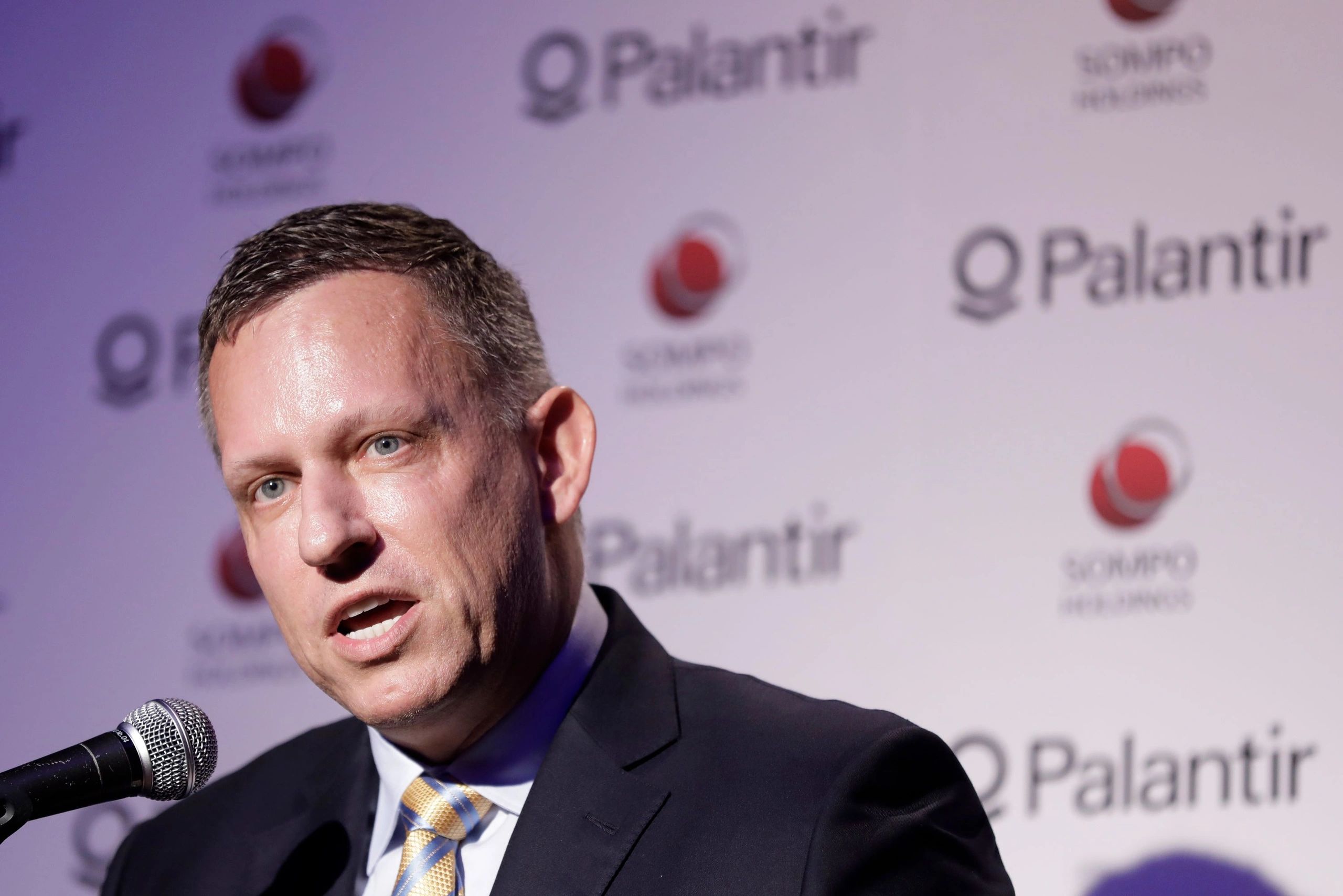
As with so many others, my first exposure to Palantir was hearing about its stock, which has been among the top performers on the market in recent years. Then, I began hearing the controversy surrounding big government contracts with the US government. A little later, I became more familiar with Peter Thiel, and some of his darker beliefs. In the wake of 9/11, Palantir entered the scene by providing tracking capabilities designed to augment the government’s ability to identify terrorist threats. I quickly realized that Palantir is not just a domestic force, but has exported its software around the globe. Once the pieces had begun to come together, I became more certain than ever that Palantir’s mission is a real and present threat to society, and not enough people are talking about it.
It almost feels as though Palantir and its representatives are purposely vague about what truly constitutes the services it provides to clients. Palantir can be most accurately be described as a master of data management, aiming to aggregate, organize, sort, and ultimately derive meaning from large datasets of their customers. For example, the Palantir Foundry, the company’s commercial branch, implements tailored data solutions in industries like healthcare, automotive, and finance. In terms of government contracts, Palantir has already inked deals with the Department of Defense, NATO, and even Denmark’s police force. On paper, it all sounds great, and its hard to find an investor that isn’t bullish on the company’s future economic success. Nevertheless, Palantir’s ‘data solutions’ stand to significantly shape the landscape of technology, security, surveillance, and law enforcement all over the world, and it’s time to take notice.
The concept, and potential dangers, of Artificial Intelligence (AI) have become the focus of a worldwide discussion on how humanity should handle the incredible power resulting from its development. Beyond fears of eliminating jobs and the extinction of the human race as a whole (how banal), we now have tangible evidence of the current damage being done by AI. Studies have emerged highlighting the threat of ‘Digital Dementia,’ a new term used to define the cognitive decline experienced by users of this technology. Findings show that overuse of AI chatbots and other softwares causes cognitive decline, including loss in memory and emotional regulation, and even reduced interpersonal skills. Another result of the growing use of Large Language Models (LLMs) is straight out of Orwell’s 1984 - the manipulation in the frequency of use of words, phrases, and more, effectively restructuring what Orwell called the ‘climate of thought,’ or simply put, the way we express ourselves. Yet, AI, and the major players behind its advancement, are the hottest speculations on the market, with the industry bringing in hundreds of billions in capital investment in 2025 alone. For more on this, check out my article, ‘Does AI Make Us Less Human?’
A loss in neuroplasticity seems trivial in the wake of actions and remarks from Palantir’s CEO Alex Karp, who once bragged that the company’s technology is being used to kill Palestinians. Karp has also issued threats to Palantir’s opposition, stating that he “loves the idea of getting a drone and having light fetanyl-laced urine sprayed on analysts that tried to screw us.” Former employees recently penned a warning letter, highlighting the violation of key codes of ethics in the handling of powerful AI technologies at Palantir. These comments run parallel to those criticizing Elon Musk and his involvement in the Department of Government Efficiency (DOGE), which many have pointed to as an example of the mishandling of sensitive personal data by an individual with severe conflicts of interest, including running private companies that receive government-sponsored financial aid. Combined with the Trump administration’s historic crackdown on free speech, the threat of the use of AI against ordinary citizens no longer feels far-fetched - it feels imminent.
Thiel and the precipitous rise of Palantir beg the question - where do we draw the line between responsible technological advancement and the abuse of its power? It is my contention that, if we fail to agree on and implement guardrails to establish solid boundaries that prevent bad actors and malicious individuals from weaponizing AI, we will soon live in a world beyond our control.
An Authoritarian’s Dream

Upon stepping back to observe the potentially dangerous use cases of Artificial Intelligence by governments, law enforcement, and the military, the overarching authoritarian agenda has become clearer than ever. With efficiency and scale driven by software and technologies like those developed by Palantir, administrations and regimes will be able to exert unprecedented control over their constituents. Much as Edward Snowden warned, “these (surveillance) programs were never about terrorism: they’re about economic spying, social control, and diplomatic manipulation. They’re about power.”
Due to the inherently exponential pace of AI development, decisions on how to deal with these dangers, and especially the overreach of governments in their utilization of it, have to be made now. After all, Sam Altman, current CEO of OpenAI and its ChatGPT offerings, has stated his belief that Artificial General Intelligence (AGI), the term for the achievement of average human intelligence by AI software, could be a reality within the next few years.
The clock is ticking, your AI is getting smarter, and Palantir is watching. Is there still time to curb the dangers of AI, or are we too late? Maybe it’s best not to ask Peter Thiel.