Recently, we’ve been hearing a lot about Trump’s favorite word in the dictionary - tariff. So, what are tariffs, and why are the implementation of them currently causing the United States to inch closer to a recession?
A Dangerous Misconception
Members of the Trump administration, and most prominently Trump himself, have been continuously spreading misinformation on the definition of tariffs, and the damage that they are currently inflicting on America’s economy, and its citizenry. Trump and his disciples have repeatedly referred to tariffs as a tax levied upon foreign countries that will result in increased revenues for the US government, and, in turn, significant windfalls for the American people. However, this is objectively false.
Tariffs are an economic tool that effectively raise the prices of goods that are imported to the United States, which ultimately leads to inflation. For instance, taxes on fruits and vegetables coming from Mexico, which totaled $250 billion in 2023, will ultimately be paid by the importers, who will now have to sell their produce at higher prices to make up the difference. So, an avocado that once cost $1, for example, will now cost $1.25 after applying a 25% tariff, which means that, when Americans go to the grocery store, they will feel the effect of this increase in price.
In an ideal world, a tariff is meant to give a competitive advantage to domestic producers of goods, and is an incentive for manufacturers to return critical infrastructure and production to the United States. However, the United States relies heavily on foreign imports of goods that can be made cheaper and more efficiently elsewhere, like Chinese imports of computers and television sets, which account for the largest portion of nearly $3.6 trillion of goods received from China in 2024. China’s manufacturing advantage comes from a variety of factors, including cheaper labor, massive factories and manufacturing plants that are subject to fair less regulation than in the United States, and an economy that has outpaced its western counterparts with an average increase of nearly 9% in GDP from 1992 to 2024. With the implementation of 10% tariffs on Chinese goods, a $1,000 TV set immediately becomes $1,100 for American consumers, and extremely limited manufacturing of TVs in America (which still rely heavily on components produced outside of the United States) makes it nearly impossible to find a comparable substitute.
One of the hardest-hit sectors will be American automakers, who have already struggled to compete with their foreign counterparts. Although cars are partially assembled and sold within the United States, they are increasingly comprised of components imported from foreign manufacturers, chief among them being the countries at the center of Trump’s cataclysmic trade war, Mexico and Canada. Moreover, the cost of moving manufacturing of these parts back to the United States is astronomical and an extremely lengthy process, which could add an average of $3,000 to the sticker price of popular vehicles at a time when the average American citizen cannot comfortably afford a car. This also does not include the impact of finding and paying American workers, who will need to fill the void to manufacture the deficit of car parts imported from other countries.
In summary, tariffs against main trading partners are not only catastrophic to US industry, but will inevitably lead to a recession and unfathomable pain for the average American. According to leading economists, this strategy is, inarguably, ‘a very bad idea.‘
The Fallout
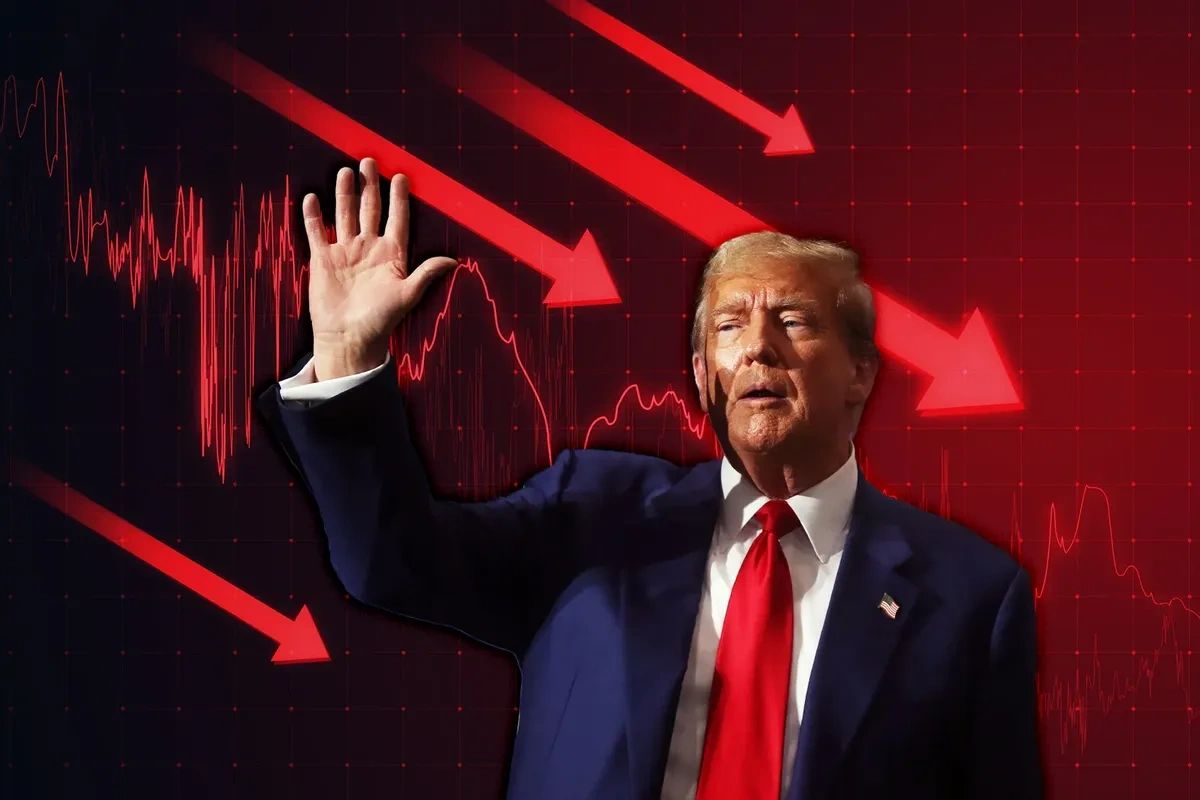
In less than 2 months, Trump’s tariffs have been the primary factor that has eliminated a staggering $4 trillion from the US stock market. Trump inherited the strongest economy in decades from Biden, which saw growth that repeatedly outpaced expectations, and low unemployment rates not seen since the Clinton administration 3 decades ago. Thus, despite the misinformation peddled by the administration, Trump has once again inherited a booming economy with solid fundamentals, first from Obama in 2017, and now from Biden in 2025.
This is not the end of the downturn either. As the markets react, Wall Street is currently scrambling to reconcile their projections for a contracting US economy, which stands to shrink by 2.8% in Q1 of 2025 alone, according to the Atlanta Fed. In response, US companies have continued mass layoffs, and the federal government has already eliminated tens of thousands of jobs in key agencies, including USAID, the Department of Education, and the Department of Veterans Affairs. Although it is true that there is certainly waste and inefficiency within these agencies, these cuts have not only left veterans and civil servants without employment, but their negative impact will be felt by America’s most-vulnerable populations, including low-income Americans who rely on programs subsidized by the US government, and US farmers, who have already had to freeze investments due to a lack of funding, and are struggling to replace workers largely comprised of illegal immigrants. In fact, Farm Aid estimates that 70% of farmworkers in the US are immigrants, and Trump’s plans to implement mass deportations may force small farmers to go out of business entirely. Furthermore, the farmers that do manage to evade insolvency will be forced to find American workers to do these difficult and low-paying jobs, and pay them significantly more than immigrants who are currently employed by them, leading to skyrocketing prices on meat, dairy, and produce.
Although the implications of these disastrous trade policies have yet to be fully estimated, there is one certainty - Americans will be paying the price, both at the grocery store and with their 401k.
What Comes Next
Trump has wasted no time in waging war against America’s leading allies and trading partners, with the EU announcing a 28% tariff on US goods in recent days. Not only do these actions hold significant financial risk, but they further serve to isolate the US in a time when the global economy is more intertwined than ever before. Although Trump could deliver relief to the US economy and American citizens by abandoning these ludicrous financial measures, the possibility looks more and more unlikely.
In conclusion, tariffs are not the glimmering road to prosperity that Trump and the Republican party profess them to be. In 2025, they serve only to increase prices for Americans, and drive the economy closer to a recession, and, ultimately, potential collapse.