The following is an opinion piece I published in 2018 on my blog, MJ Journalism.
As globalization continues to seep its way into everyday life for billions of people, the evidence that the world might not be ready for such a paradigm shift continues to grow. This evidence is conceivably the strongest in the United States, which has been forced to come to terms with its waning influence in the 21st century as other ‘superpower’ nations develop into worthy opponents.
With the devastation of the Great Recession seared into the memories of Americans, the 2016 Presidential Election was often cornered into focusing on the one thing about which citizens cared the most: employment. It is no secret that, with the advent of artificial intelligence and increasingly fluid international borders, American jobs have taken a hit. America is no longer the manufacturing powerhouse that it was during the Industrial Revolution, and it seems that it may never have the chance to be one again. The ever-present reality that jobs can be done remotely, more cheaply, or even entirely by computers is tightening its grip on the purse strings of working Americans. Now, ‘Joe the Plumber,’ to whom Donald Trump promised so much, has been left high and dry, and without recourse.
The problem of the diminishing demand for American workers has only been exacerbated by the incendiary rhetoric of the Trump administration concerning global trading partners and alliances of the United States. Trump has long been a critic of multilateral trade deals in which the United States is involved, and the resulting bitterness has only isolated America, effectively providing a pathway for other superpowers to fill the void of world leadership. China and Russia, united by their mutual interest in Russian oil and China’s rampant appetite for energy, have formed an unwritten alliance that centers around the domination of the developing East. Although Trump has incessantly boasted of his ability to develop rapport and transact business with Russian President Vladimir Putin, his words have yet to come to fruition. As someone who has spent a good deal of time in the post-Soviet space and with a decent understanding of Russian politics, I assert that Putin never had any intentions of cooperating with Trump; he is simply too brilliant and cunning a politician, and would be remiss to support the United States in any venture that might run the risk of shrinking Russia’s sphere of influence. Who said the Cold War was over?
So, what does this mean for Americans? Well, the reality isn’t promising. Despite the fact that US unemployment has reached record lows in recent months, US companies continue to grapple with open positions that they cannot seem to fill. The problem does not have to do with the availability of candidates, but rather with the skillsets of these candidates. As the American education system continues to fall short of its European and Asian counterparts, and domestic higher education has reached inexplicably high prices, the job market is struggling to adjust to the new reality that it cannot take certain applicants’ skills for granted. A prime example of this is the lack of interpersonal skills that many college graduates now exhibit: as technology has reached new heights, it has also stripped many young people of the ability to interact with the world around them. This decrease in face-to-face contact in the general population has resulted in decreased capabilities of a social nature: empathy, work ethic, literacy, and many other of the essential components of a successful employee have seemingly disappeared into the abyss of Twitter, Snapchat, Facebook, and other replacements for the social experience. Consequently, simply holding an advanced degree just isn’t enough anymore.
Of course, this sad actuality is not helped by the fact that many recent graduates are bogged down by student debt that totals over 1.4 trillion USD, debts that will remain unpaid until these students integrate into the workforce. To make matters even more grim, vacancies at American companies will only continue to grow as the Baby-Boomer generation reaches and prepares for retirement. Since I don’t want to sound too morose, I won’t bother delving into the ticking time bomb that is Social Security, an institution that many Millennials will never experience, or at least not on the receiving end.
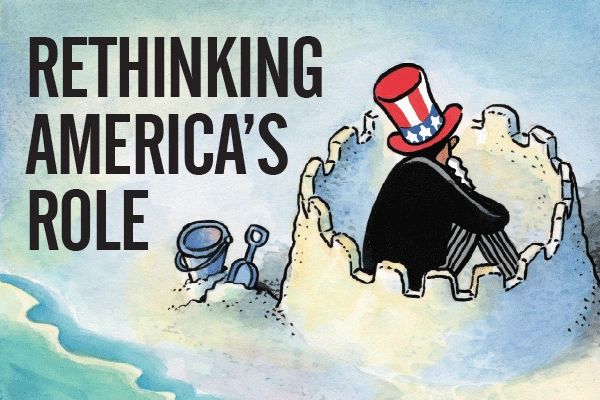
I don’t pretend to have the answer to America’s employment woes, but I do remain certain about one thing: fighting against the wave of globalization will only result in America finding itself on its back on the shore of the world. At the risk of being cliché, the effects of globalization have reached a point of no return. Unlike in times past, America cannot withdraw into itself as the rest of the world continues to blend. For a figure who seems to be unable to resist speaking his inner thoughts, it appears as though Donald Trump hasn’t considered the consequences of being excluded from the global conversation.
Just as it is proposed in economic theory, the paradigm of core competencies can be applied to this discussion. Contrary to the past, when the United States could assert its dominance by flexing its military muscles and tapping into its colossal coffers, being the best in the world at everything is simply not possible. Russian hackers have conquered American counterintelligence time and again, and it is unlikely that this effort will be curtailed by Putin and the Kremlin. China’s economic growth is virtually unmatched on the world stage, and it is only a matter of time before China will be the world’s #1 economy. Today, India graduates more English-speaking engineers than the United States. The point is this: when it comes to competition, focus on your strengths.
Home to the world’s largest technological community, the strongest (and growing) financial market on the planet, and the epicenter of global politics and culture, America has a lot to offer. By stepping away from the negotiating table, the United States risks being shut out from the phenomenon of globalization. It is time that America’s foreign policy matches its sovereign ideals: equality and diversity make us stronger, for our differences fill in the gaps that we cannot fill alone.